BFCM 30% OFF ALL LIVE FEEDS
Every live feed is 30% off—Tisbe, Apocyclops, Rotifers, Phyto, and more. Limited-time BFCM deal!
BFCM30

Non-Photosynthetic (NPS) Corals: A Comprehensive Care Guide
Non-Photosynthetic (NPS) corals are a unique group of reef corals that do not rely on light for sustenance. Unlike typical photosynthetic corals, NPS corals lack symbiotic zooxanthellae algae in their tissues and thus **derive **no energy from photosynthesis. This fundamental difference means NPS corals must capture and consume food to meet 100% of their nutritional needs. In this guide, we’ll explore what sets NPS corals apart, their natural habits and diet, and detailed best practices for keeping these beautiful but demanding corals in a home aquarium. We’ll also highlight specific NPS species (Tubastraea, Dendronephthya, “Chili” coral, and NPS gorgonians) and provide practical care tips for each. Finally, we’ll recommend some foods, supplements, and equipment to help you succeed with your own NPS coral tank.
What Makes NPS Corals Different?
In nature, most reef-building corals live in symbiosis with microscopic algae (zooxanthellae) that live in their cells. The algae perform photosynthesis and share nutrients with the coral host. NPS corals, however, do not contain zooxanthellae – hence the term “azooxanthellate” often used to describe them. Without a solar-powered food source, NPS corals must actively feed on external foods to survive. This distinction leads to several important differences in biology and care:
In short, an NPS coral tank is almost the inverse of a typical reef tank: low light but heavy feeding. Mastering the care of these corals means understanding their constant hunger and providing the right environment for them to feed and grow.
Natural Habitats and Feeding in the Wild
To successfully keep NPS corals, it helps to mimic their natural habitat and food availability. In the wild, NPS corals are often found in environments quite unlike the sunlit shallow reefs we imagine. Key characteristics of their natural setting include:
Bottom line: NPS corals naturally reside in low-light, high-flow areas teeming with planktonic food. They are adapted to capture huge amounts of small prey around the clock. When designing an NPS aquarium, we must replicate these conditions as closely as possible – providing ample food and water movement, while not worrying much about intense lighting.

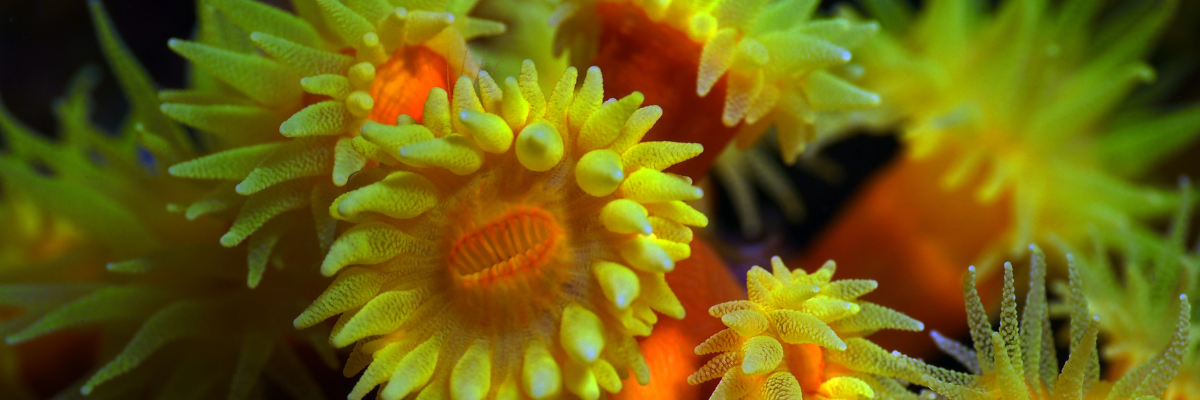
Sun corals (Tubastraea spp.) extend vibrant tentacles to snare plankton from the water. In the wild, these NPS corals live on dimly-lit cave walls and reef slopes where currents deliver a constant rain of food. Their lack of symbiotic algae means they must capture prey for energy.
Essential Aquarium Conditions for NPS Corals
Keeping NPS corals healthy in an aquarium poses a special challenge: how to feed heavily without polluting the tank. You’ll need to create an environment that meets their needs for low light and strong flow, and develop a feeding regimen that provides constant nutrition. At the same time, robust filtration and diligent maintenance are critical to manage water quality. Here we break down the key aspects of NPS coral care in captivity:
Tank Setup: Low Lighting and Strong Flow
Lighting: The good news is NPS corals do not require intense reef lighting – in fact, they prefer much dimmer conditions. In nature these corals often live in darkness, so bright lights in the tank are mostly for your viewing pleasure. Many aquarists with dedicated NPS tanks run only ambient room light or very low-intensity LEDs (sometimes just a blue moonlight glow to simulate deep water). High light can be problematic because it encourages nuisance algae on NPS corals (since the corals don’t have algae of their own, any algal growth is unwelcome). Placing NPS corals in shaded areas of your aquascape (beneath rock ledges or in caves you build) is a good strategy. This keeps them out of direct light and more closely mimics their natural homes. That said, it’s a myth that you must keep an NPS tank completely dark at all times – many people successfully keep sun corals or gorgonians in moderately lit mixed reefs by simply situating them under an overhang. The key is to avoid intense lighting on the coral’s tissue which could spur algae or cause the coral to stay retracted.
If you have a dedicated NPS display, you can use a very subdued lighting schedule (e.g. a short period of low-level lighting for viewing each day). Using an adjustable LED fixture (like a controllable Kessil light) allows you to dial the intensity way down. Remember, any photosynthetic organisms (like fish-harboring algae or other corals) will be limited by the low light, but the NPS corals will be perfectly happy. Pod Your Reef even offers a PAR meter rental service if you want to verify how dim your tank is – though in an NPS tank you might be measuring how low you can go rather than how high!
Flow: Water movement is absolutely crucial for NPS corals. In nature, they reside in high-flow zones and depend on currents to constantly bring them food. In your aquarium, aim for strong, randomized flow throughout the day and night. Powerful wavemaker pumps or a closed-loop system can achieve this. You’ll want to eliminate any “dead spots” where food can’t easily reach the coral. Alternating or turbulent flow is ideal – it helps deliver food particles to all sides of the coral and also carries away wastes. Many NPS keepers use multiple pumps (e.g., a gyre pump plus a propeller pump) to create complex flow patterns.
One consideration is not to “blast” the coral so hard that it can’t open its polyps. NPS corals can handle a lot of flow, but not so much that their polyps are flattened or unable to grab food. For instance, non-photosynthetic gorgonians thrive in swift currents, but if the flow is too direct and laminar, their delicate polyps might stay closed. A good rule of thumb is if you see the coral’s tentacles extended and gently swaying, the flow is sufficient; if the polyps never come out or the coral seems to shrink away, try adjusting the direction or intensity.
In practice, providing strong flow might mean running powerheads at higher settings or using wave action modes. Also consider periodic surge or pulsing flow which can simulate the tidal currents NPS corals often experience. When placing your corals, put them in areas of the tank that naturally get higher circulation (e.g., near pump outputs or in the path of a gyre). As an example, a Tubastraea sun coral could be positioned under a rock ledge that’s facing a pump output – replicating that cave ceiling scenario where water (and food) rush in continuously.
Summary: Keep lighting low and subtle, mainly for aesthetics. Provide vigorous, multi-directional flow at all times. This combination will help your NPS corals feel “at home” – comfortable opening up to feed, without being overrun by algae or detritus.
Feeding Strategies and Schedule
Feeding NPS corals is the single most important (and time-consuming) aspect of their care. Since these corals get all their nutrition from food you provide, you must feed them frequently and appropriately. A good mantra is: feed heavily, but feed smartly. Below, we’ll cover what to feed, how often, and techniques to ensure your NPS pets get enough to eat without crashing your water quality.
Diet and Food Types: NPS corals consume a wide variety of plankton and particulate foods. To keep them healthy, you should offer a mix of foods spanning different particle sizes, from tiny phytoplankton up to meaty zooplankton. This ensures each coral (whether it has minute filter-feeding polyps or large mouths) finds suitable nourishment. Common foods for NPS corals include:
Feeding Frequency: Given their high metabolic needs, NPS corals should be fed daily – and ideally, multiple times per day. A good starting point is to ensure at least one substantial feeding session every day (where you really saturate the water with plankton food or target feed each coral well). However, most NPS enthusiasts find 2–3 feedings per day yields much better results, especially for very demanding species. Remember, in the wild they feed constantly, so the more frequent your feedings (within reason), the more you mimic natural conditions. Small, frequent feedings are better than one huge dump of food. For instance, you might broadcast feed rotifers/phyto in the morning, spot-feed some meaty food at midday, and broadcast a mix of particle foods in the evening.
Some advanced techniques include using an automatic dosing pump or drip system to add plankton continuously. Hobbyists have rigged refrigerated containers to slowly drip feed phyto and rotifers overnight, ensuring corals have access to food across many hours. While not everyone will go to that extreme, it underscores the point: consistency and frequency are key. A coral like a carnation (Dendronephthya) will slowly starve if it only gets fed a few times a week – it really needs near-constant feeding opportunities. In general, observe your corals’ reaction: if they open up eagerly at a certain time or right after a feeding, that’s a sign to keep that schedule. If a coral remains closed often, you may need to adjust timing or type of food.
Feeding Techniques: There are two primary ways to feed NPS corals:
In practice, you’ll likely use both methods. For instance, you might broadcast feed fine particles nightly for your filter feeders, and a few times a week target feed your sun coral some meaty treats to ensure its calorie needs are met. Consistency is critical – try to stick to a routine so the corals “learn” when to open. Many NPS corals can be trained by feeding at the same time each day. They will begin to extend polyps in anticipation (some even learn to open when the tank’s feeding pump turns off, as they associate still water with dinner time!).
Product Recommendations – Foods: To implement your feeding plan, here are some Pod Your Reef products that can help make feeding NPS corals easier and more effective:
By offering a varied diet and sticking to a frequent schedule, you’ll meet the substantial dietary demands of NPS corals. Remember, a well-fed NPS coral will exhibit fuller flesh, open regularly, and show growth; a poorly fed one will gradually shrink or stay closed. When in doubt, feed a little more, and monitor water quality (we’ll talk about managing nutrients next).
Filtration and Nutrient Management
All that feeding we just discussed has a flip side: lots of food = lots of waste in the water. If you simply dump copious food into a closed aquarium, water quality will deteriorate – ammonia, nitrate, and phosphate will spike, leading to algae blooms and unhealthy conditions. Thus, a critical part of NPS coral keeping is implementing robust filtration and nutrient export to handle the extra load. The goal is to feed generously and maintain excellent water quality. Here are strategies to achieve that balance:
Tip: It’s a balancing act – you want some nutrients (NPS corals don’t like sterile water either), but not so much that algae or cyanobacteria overrun the tank. In practice, having a bit of measurable nitrate (2-10 ppm) and phosphate (~0.01-0.1 ppm) is fine, even beneficial, for an NPS system. The key is avoid extremes: don’t let nutrients hit zero (corals starve) and don’t let them skyrocket (corals stress and algae blooms). With robust filtration and mindful feeding, you can ride that middle ground. Test your water regularly for nitrate and phosphate, especially as you scale up feeding. If you see trends upward, respond with adjustments in feeding quantity or filtration.
Finally, good husbandry is crucial: siphon out detritus from the sump and display often (decaying uneaten food can accumulate in rock crevices), clean your skimmer and pumps so they work efficiently, and prune your macroalgae/refugium routinely. Running an NPS tank can be heavy on maintenance, but it’s necessary to keep the environment healthy for these corals. A Reef Reef Food Selection Chart can help plan a feeding regimen that your filtration can handle. And if you want to be extra sure about water chemistry, you can use ICP test kits (like Triton test) to monitor any chemical imbalances over time due to unusual feeding inputs.
Maintaining Stable Water Parameters
Beyond filtration, you should aim to maintain overall stable water parameters just as you would in any reef tank. NPS corals may not need light, but they do share similar preferences for temperature, salinity, and basic water chemistry:
In summary, treat water parameters as you would for a sensitive reef tank: stable and within natural seawater ranges, with a bit of nutrients allowed. By achieving a balance of heavy feeding and heavy nutrient export, you provide nutrient-rich food inputs but keep the residual nutrient levels modest. This is the crux of NPS coral care – and it can absolutely be done with careful planning and consistent maintenance. Many modern reef keepers are rising to this challenge and enjoying success with these once “impossible” corals.
Species Spotlights: Notable NPS Corals and Their Care
Now let’s look at some specific NPS coral species popular with hobbyists. Each has its own quirks and care requirements. We’ll cover the ones mentioned in the prompt and a few notes on each:
Sun Corals (Tubastraea spp.)
Overview: Sun corals (genus Tubastraea) are perhaps the most well-known NPS corals in the hobby. They are large-polyp stony corals (LPS) belonging to the family Dendrophylliidae. Sun corals form clusters of cup-like calcareous skeletons with plump polyps that come out of each cup. Common varieties include Tubastraea faulkneri (orange sun coral), T. coccinea (orange with smaller polyps), and T. micranthus (black sun coral, which has a dark skeleton and neon green polyps). When open, a sun coral colony resembles a bouquet of bright orange/yellow “sunflowers” – hence the name.
Feeding: Tubastraea have fairly large mouths and thick tentacles, allowing them to eat relatively large meaty foods. They love live food and zooplankton – feeder brine shrimp, mysis shrimp, small pieces of clam or squid, etc. are readily accepted. They will also capture smaller particles like cyclopeeze and copepods if available. In an aquarium, each polyp should ideally be target fed a few times a week with nutrient-dense foods (mysis soaked in vitamins, for example). Sun corals extend tentacles mostly at night, but you can train them to open during the day by offering food consistently around the same time. Often, just adding some food to the water (e.g. squirting a bit of brine shrimp juice) will cause the polyps to “smell” food and come out. Once open, you can target feed each head. Their polyps can ingest surprisingly large items (a big polyp can swallow a whole mysis shrimp). They are not picky eaters – Tubastraea will take almost any kind of meaty fare when hungry. A healthy, well-fed sun coral grows new buds/polyp heads over time, eventually covering its rock with more cups.
Placement & Lighting: In the wild, sun corals are found under ledges and in caves, so they appreciate shaded areas in the tank. They do not need or want bright light – algae can overgrow their skeleton if lit intensely. Place them in a low-light, high-flow spot. Many hobbyists wedge them in cave-like spots in rockwork. You can orient them vertically or upside-down on a ledge, similar to their natural position, so that when they open, gravity doesn’t let heavy foods fall out of their polyps easily (this is a neat trick – feeding upside-down sun corals in a cave can actually make it easier for them to catch food!). Ensure moderate to strong flow to carry food to them, but not so much that it rips food away mid-feeding.
Care Level: Sun corals are considered one of the easier NPS corals – often recommended as a “first NPS” for reefers. They don’t require constant feeding like some soft NPS do, and they are relatively hardy and tolerant of less-than-perfect water quality (within reason). The main challenge is regular feeding of each polyp. If you neglect feeding, they will languish. But with diligence, many aquarists keep sun corals thriving even in mixed reefs. They don’t sting other corals, but give them space so that when their tentacles extend (which can be quite long at night) they aren’t bumping into neighbors.
Special Notes: Handle sun coral colonies carefully – their polyps are sensitive to physical damage. The tissue can be torn if rough-handled, leading to infection. When moving them, try not to touch the soft tissue; handle by the hard skeleton if possible. Also, Tubastraea micranthus (black sun coral) is notably more difficult than the orange species – it tends to have very high feeding needs and lower tolerance for nutrient buildup, so attempt that one only if you have had success with the orange variety. As a final note, Tubastraea are non-photosynthetic but invasive in some regions (they’ve spread in the Atlantic); never release them into the wild.
Carnation Tree Corals (Dendronephthya spp. and Scleronephthya spp.)
Overview: Often called carnation corals, tree corals, or cauliflower soft corals, Dendronephthya are among the most beautiful – and challenging – NPS corals. They are soft corals that grow in brightly colored tree-like forms with branches covered in tiny polyps. Colors range from hot pink to red, orange, purple, even multicolored with yellow or white polyps. These corals lack any rigid skeleton, but they have internal calcium spicules for some support. Carnation corals are found in strong flow areas of Indo-Pacific reefs, often hanging on walls or caves. They are truly eye-catching, but have a reputation as “expert only” corals because historically most waste away in captivity.
Feeding: Dendronephthya have very small polyps – think of tiny flower petals – which indicate they require extremely fine food particles. In the wild, studies suggest they feed on nanoplankton and bacterioplankton in addition to small zooplankton. In aquaria, they prefer small live foods like rotifer-sized prey, Artemia (brine shrimp) nauplii, copepod nauplii, and colloidal particles often termed “reef snow”. They will take some phytoplankton and dissolved organics as well. The difficulty is delivering enough of these tiny foods continuously. A carnation coral might need to capture tens of thousands of food particles per day to meet energy demands. Thus, success usually requires an automated feeding setup that doses rotifers and other micro-foods throughout the day/night. Target feeding is impractical due to the number of polyps. Reef snow, fine zooplankton, rotifers, and micro-plankton mixtures are ideal. Many people who have kept these corals long-term feed the tank heavily every 2-3 hours, or run a near-continuous drip of plankton. It’s an intensive regimen. Even then, Dendronephthya often slowly shrink over months if any aspect of feeding is insufficient.
Flow & Placement: These corals need strong, but carefully tuned flow. They rely on flow to bring food, but if the flow is too violent, their polyps cannot open or catch anything. In a tank, placing them in an area of brisk, indirect flow is best – for example, at the edge of a powerhead’s stream rather than directly in front of it. They often do well oriented vertically (like a tree standing upright) in a spot where upward flow can bathe them. Dendronephthya often do better in species-dedicated NPS tanks because you can crank the flow high and fill the water with food without worrying about other corals. They like to be upright (some have root-like holdfasts to anchor in substrate in the wild) or wedged in rock crevices with good current. Keep them in dim areas; although they don’t mind moderate blue light, bright lights can encourage algae on their tissues which they cannot combat.
Care Level: Expert Only. Carnation corals are notoriously difficult – so much so they are considered a “flagship” of NPS challenges, with very few people able to keep them alive long-term. They should not be attempted by beginners or in mixed reefs where you can’t devote special care. If you do attempt them, it should be in a mature, well-filtered aquarium with established microfauna, and you must be prepared for extensive feeding efforts. On the positive side, if they do acclimate and feed well, they grow relatively fast (they don’t calcify, so growth is just expansion and new branches). You might see new buds or branches forming if it’s thriving. Unfortunately, most often these corals slowly starve in typical aquariums. Therefore, it’s recommended to gain experience with easier NPS species first, or ensure you have a true dedicated NPS system, before keeping carnation corals. Some public aquariums have had success with automated feeding systems that literally pump concentrated plankton into the tank hourly.
Special Notes: There are multiple genera sold as “carnation corals,” including Scleronephthya which is similar. Care for all is the same – intensive feeding and flow. If your carnation coral starts to deflate or lose color, it’s often a sign of inadequate nutrition. They don’t brown out (since no zooxanthellae), but they might turn pale or slough off tissue when stressed. On a hopeful note, in recent years there have been incremental successes in keeping and even propagating Dendronephthya by advanced hobbyists, thanks to better feeding technology and knowledge. They remain a coral for the truly determined aquarist.
Red “Chili” Coral (Alcyonium sp., sometimes Nephthyigorgia)
Overview: The so-called Chili coral (or Strawberry coral) is a soft coral that is relatively more attainable among NPS species. It gets its name from its appearance – typically a bright red, elongated, knobbly body with white polyps, resembling a red chili pepper. Taxonomically it has been assigned to Alcyonium, Nephthyigorgia, or Scleronephthya in various sources, but hobbyists simply know it as the Chili coral. It is a soft, leather-like coral with no hard skeleton. During the day, it often looks like a deflated red blob, and at night it “blooms” as countless tiny white star-like polyps cover its surface. Chili corals are found in shaded reef areas, often attached under ledges or caves. They are among the more hardy NPS corals and are sometimes found as “hitchhikers” on live rock (to hobbyists’ surprise).
Care Level: Generally considered moderate, or even “Beginner NPS”. While easier than many NPS, they still need regular feeding to do well. They have been kept successfully in mixed reefs as long as they are placed appropriately and target fed.
Feeding: Chili corals have small polyps (though larger than Dendronephthya polyps) – they appear as a dusting of white when extended. They feed on fine zooplankton. In captivity, they do well with foods like baby brine shrimp, rotifers, cyclops, oyster feast, and other micro-plankton. They adore live brine nauplii and cyclopeeze in particular. Since they often expand at night, it’s a good practice to feed them after lights-out: use a pipette to gently squirt some planktonic food around the coral once it has opened. They will also capture what they need from broadcast feedings done for other NPS corals. Aim to feed at least every other day, if not daily. A well-fed chili coral will stay inflated longer and might even open polyps in daytime if it’s hungry and anticipates food.
Lighting & Placement: True to their nature, chili corals prefer darkness or very low light. They should be placed in a fully shaded spot – under a cave, overhang, or even upside-down attached to a rock ledge. Direct light can cause algae or cyanobacteria to grow on them, which is harmful. They also seem to retract under bright light, so even if you feed, they won’t open unless it’s dark enough. So find a nice dark corner of your aquascape for the chili coral. Strong flow is a must; they like a little more flow than average to keep them clean and bring constant food. If detritus settles on them, they can develop dead patches, so that strong flow helps “blow them off.” You’ll often see them sold attached to the underside of a small rock or even a plug that you can wedge somewhere out of light.
Behavior: Chili corals typically expand polyps during dark periods. Don’t be alarmed if during the day the coral looks closed/deflated (like a red sponge or potato). This is normal. Once the lights go off, check a couple hours later – it should plump up and white fuzzy polyps will emerge. If it’s not opening even at night, try adjusting flow (they might want more) or ensure no hermit crabs or fish are bothering it. These corals can sometimes take a week or more to settle in and start opening regularly. When open and healthy, they have a beautiful contrast of red and white.
Growth and Propagation: Chili corals grow slowly by branching or forming new “nodes” off their base. They can sometimes propagate by fragments – if a piece breaks off, it might form a new individual, but intentional fragging is not common. They don’t have stinging sweeper tentacles, so they are generally safe near other corals, though they can become a perch for algae if in light (which then can spread, so keep them isolated in their dark spot).
Tips: Because they are reasonably hardy, chili corals are a good candidate to start with when venturing into NPS. Make sure to brush off any algae that might grow on their base (you can gently scrub the red tissue with a soft brush if the coral is closed, to remove algae – they have a somewhat leathery skin that can handle careful cleaning). Consistent feeding at night will keep them thriving. Many people report them as long-lived when these needs are met.
Non-Photosynthetic Gorgonians (Sea Fans & Sea Whips)
Overview: Gorgonians are branching coral-like colonies, many of which are photosynthetic (like the purple sea whip or green rod gorgonian). However, there are stunning non-photosynthetic gorgonians that lack zooxanthellae and must be fed. These often have bright red, orange, or yellow branches with contrasting polyps (commonly white). Examples include the Red Finger Gorgonian (Diodogorgia nodulifera), Yellow Finger Gorgonian (similar species, yellow branches, white polyps), various Menella spp. sea fans (orange or yellow with white polyps), Swiftia sp. (usually orange polyps), and Acabaria sp. Some black corals (Antipatharians) also fall under NPS filter-feeders, though those are extremely rare in hobby. NPS gorgonians bring gorgeous structure to an NPS tank – their fans and branches create a natural “reef wall” look.
Feeding: NPS gorgonians typically have small polyps that capture plankton. They feed on items like cyclopeeze, baby brine, rotifers, Artemia nauplii, and other micro-plankton. They will also snare larger particles if their polyp size allows – for example, some species with bigger polyps might take mysis fragments. In general, plan to broadcast feed these gorgonians at least once daily with a fine food mix. You’ll see their polyps extend (usually looking like little eight-pointed stars along the branches) and snatch food from the water. Many keepers target feed by gently blowing food across the gorgonian with a pipette, ensuring the cloud passes through its branches. Regular feeding is needed for growth; otherwise, they slowly lose tissue. The Red/Yellow finger gorgonians have relatively large polyps and are known to readily eat Calanus and brine shrimp in addition to smaller items. On the other hand, species like Swiftia have tinier polyps that need microfoods. Most of these gorgonians can be satisfied with a diet of mixed plankton (frozen or live) offered daily to every other day.
Flow & Placement: Gorgonians, being upright branching filter feeders, absolutely need strong flow. They thrive in a high flow area of your tank. Aim a powerhead toward but not directly on them, so that water streams through their branches. The polyps should be extended and waving, not flattened. They can handle very high flow as long as it’s somewhat laminar or surge-like (random extremely turbulent flow could damage flesh). In nature, sea fans often orient perpendicular to the current to maximize food capture – you can mimic this by placing the gorgonian such that the broad side faces the oncoming flow. Low light or shaded placement is advised since these are NPS. Some can tolerate moderate light, but intense light will cause algae to grow on the branches which can smother the coral. A big issue with NPS gorgonians is algae or cyanobacteria overgrowth on their branches in lit tanks. If you notice algae starting to coat a gorgonian’s tissue, reduce the light or gently clean the branches (using a soft toothbrush, very gently, or by employing algae-eating snails that might pick at the algae without harming the coral). Best practice is to keep them in dim sections or have nutrient control tight so algae doesn’t bloom.
Mount gorgonians by gluing their base to a rock or wedging it securely. Ensure no other coral’s sweeper tentacles can reach them (gorgonians can be stung and have little defense aside from a nasty smell/taste to deter predators). Some NPS gorgonians like Cirrhipathes (wire corals) are actually very thin and need lower flow to feed, but those are uncommon. The ones like Diodogorgia and Menella are moderate care.
Care Level: Moderate (Intermediate). Many aquarists have success with NPS gorgonians as long as they feed them regularly and keep algae at bay. They are certainly easier than something like Dendronephthya. Red/Yellow Finger Gorgonians are often sold and, with proper care, can live for years in captivity. They do require ongoing attention to feeding and water quality, but they are not as quick to decline as carnation corals if you miss a feeding or two. Still, they are non-photosynthetic, so neglect will eventually cause starvation. They are a good choice to pair with sun corals and chili corals in a dedicated NPS display, or even as accent pieces in a large mixed reef (provided they get their special feeding).
Notes: One quirk: avoid housing NPS gorgonians with seahorses or pipefish. Seahorses love to hitch on branches, but they can inadvertently damage the gorgonian – hobbyists have found seahorses can strip the polyps off the skeleton by constantly grabbing onto them. Also, seahorse tanks often run cooler and maybe dirtier, which might be fine for the coral but the physical damage is the main issue. Otherwise, these gorgonians make great additions. Watch out for shed waxy coatings – gorgonians periodically shed a layer of tissue to remove algae and dirt. When this happens, they may close up for a few days and develop a waxy look, then slough off the layer. This is normal; increase flow to help them shed. Afterward they usually open nicely.
Lastly, Sea Pens and Sea Fans (like Ptilosarcus, Swiftia) are related to gorgonians and also NPS. They often need similar care: deep substrate for sea pens, and frequent feeding. Sea pens will embed in sand and can be target fed as they emerge at night. They are less common in trade, but if you attempt one, treat it like an NPS gorgonian (feed tiny foods often, keep in dim, gentle flow that still brings food).
By understanding the particular needs of each species – from the hearty sun coral to the delicate carnation coral – you can tailor your care routine accordingly. It’s often wise to start with the hardier NPS corals (sun, chili, maybe a hardy gorgonian) to build your feeding and filtration regimen. Once you’re confident in maintaining water quality with heavy feeding, you can try more demanding species.
Final Tips for Success and Further Resources
Keeping a tank full of Non-Photosynthetic corals is a rewarding challenge. When you see your sun corals happily open during the day begging for food, or witness a gorgonian sea fan filter-feeding in full glory, you’ll know your hard work is paying off. A few closing tips to improve your odds of success:
Cultivating a thriving NPS coral aquarium is definitely an advanced endeavor, but with the right knowledge and tools, it’s achievable. Your reward will be a truly mesmerizing reef display – one that comes alive after dark, full of unusual and beautiful creatures many reefers never dare keep. By following the guidance in this article – providing low light, strong flow, tons of appropriate food, and vigilant filtration – you’ll greatly increase your chances of success.
Happy reefing, and happy feeding! With commitment and care, your NPS corals can become the highlight of your marine collection. Enjoy the process of learning and observing – there’s always something new to discover in the world of non-photosynthetic reefs.